Why this post exists
Almost every week someone on the phone asks why there is a dolly line on their estimate. It is a fair question, and the honest answer is mostly about your vehicle, not about us. Below is what we tell people when they ask, written down once so you can read it before you call.
Written for Edmonton drivers. Last reviewed November 2026.
The short version
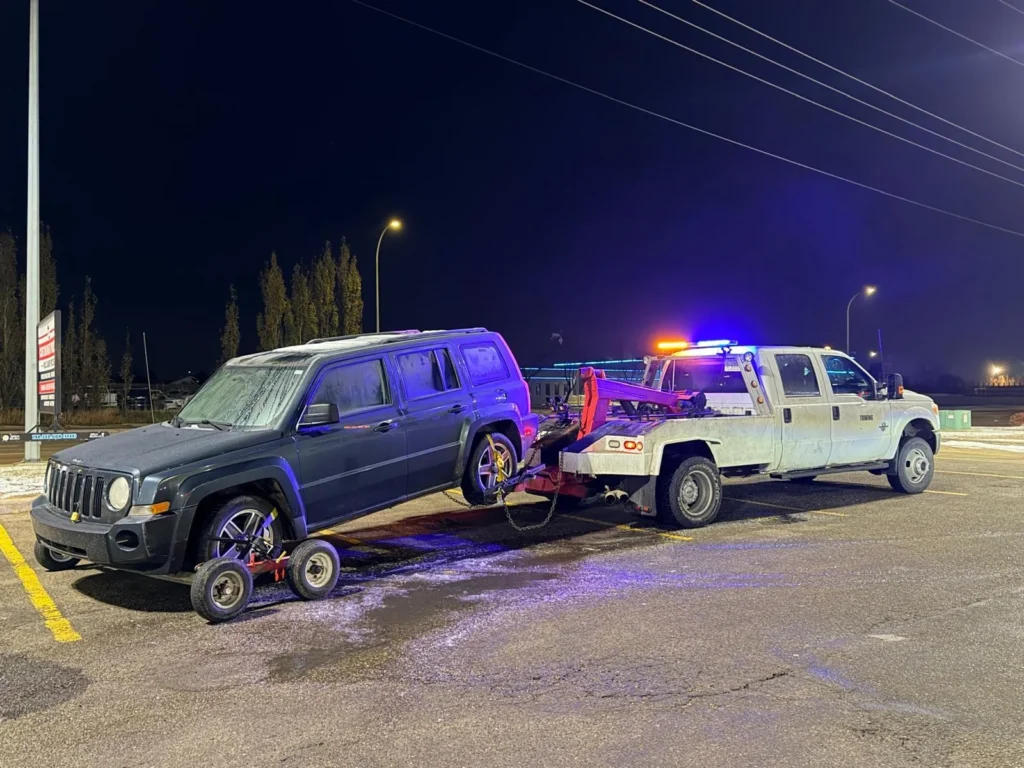
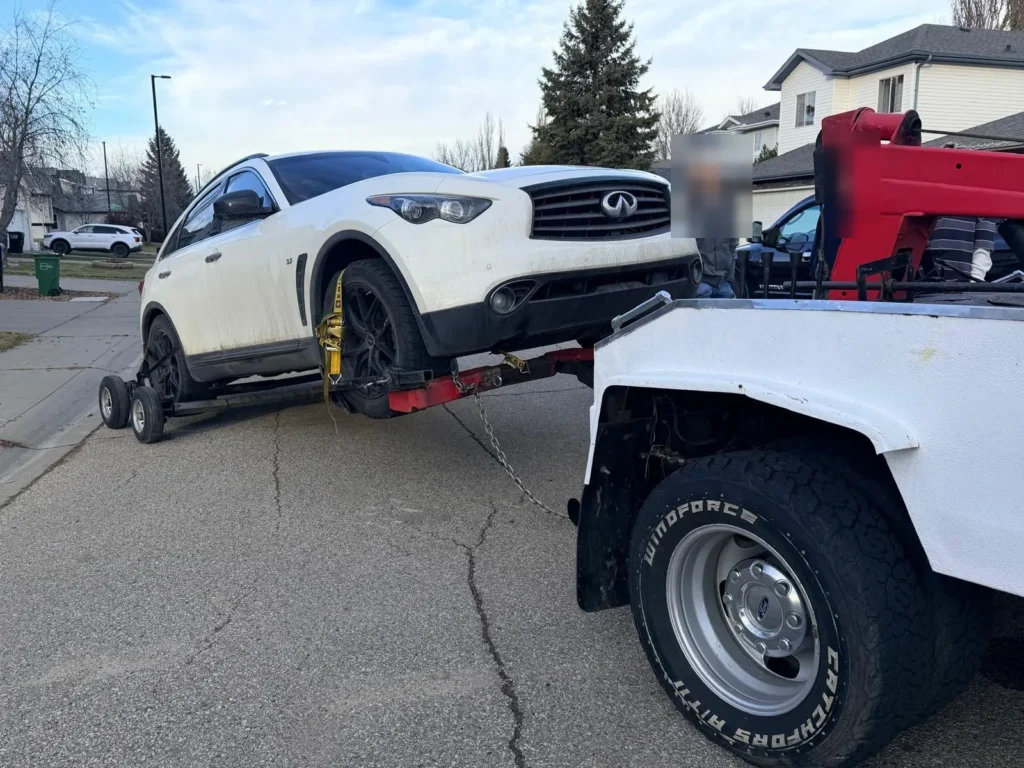
If your vehicle is all-wheel drive, the safe way to move it is with all four wheels off the road. Our truck lifts one end with the wheel lift. Dollies go under the other two wheels. Nothing touching the pavement turns, so nothing inside the drivetrain is forced to move while the engine is off.
Towing an AWD vehicle with two wheels still rolling on the road can damage the parts that split power between the front and rear axles. That repair costs far more than any tow. It is the reason vehicle makers tell you, in the owner’s manual, how their vehicle may and may not be towed.
What actually goes wrong without dollies
On a front-wheel-drive car, lifting the front wheels takes the driven wheels off the road. The rear wheels just roll freely, like a trailer’s. That is why a normal front-drive sedan can go on the wheel lift alone.
An AWD vehicle is different. Its front and rear axles are linked through a centre differential, a coupling or a transfer case, depending on the design. Lift the front and let the rear roll, and the rear wheels turn that linkage while the front wheels sit still in the air. The parts in between are now being asked to slip for kilometres. They were built to share power between two axles that both turn. They were not built to have one axle dragged while the engine is off.
The usual results are heat, worn clutch packs in the coupling, and damaged transfer case internals. With the engine off, the pump that would normally circulate fluid through some of these parts is not running either. None of this shows up at drop-off. It shows up weeks later as a shudder, a clunk on tight turns, or a warning light. By then nobody can easily tell you what caused it.
“My vehicle is 4WD, not AWD. Does that matter?”
Sometimes. Many trucks and some SUVs have part-time four-wheel drive. Their owner’s manuals allow towing with the transfer case in neutral, and with that set correctly the vehicle can be moved with two wheels down. Others cannot. Newer full-time systems often behave like AWD.
We do not guess. If the manual allows a two-wheels-down tow and the transfer case actually goes into neutral, we will tell you so. If either is unclear, the vehicle goes on dollies. Being wrong costs you a transfer case. Being careful costs you one line on the estimate.
When a front-drive car needs dollies too
Dollies are not only for AWD. We also use them when the wheels that would roll on the road cannot roll safely:
- After a collision. A bent wheel, a broken control arm or a tire pushed into the fender will not roll straight. Dragging it makes the damage worse and can make the tow itself unsafe.
- Parking brake locked or frozen. In an Edmonton winter, rear brakes freeze to the rotors more often than people expect.
- Locked in Park, with no key or a dead battery. If the transmission cannot be put in neutral, the wheels on that axle are not free to turn.
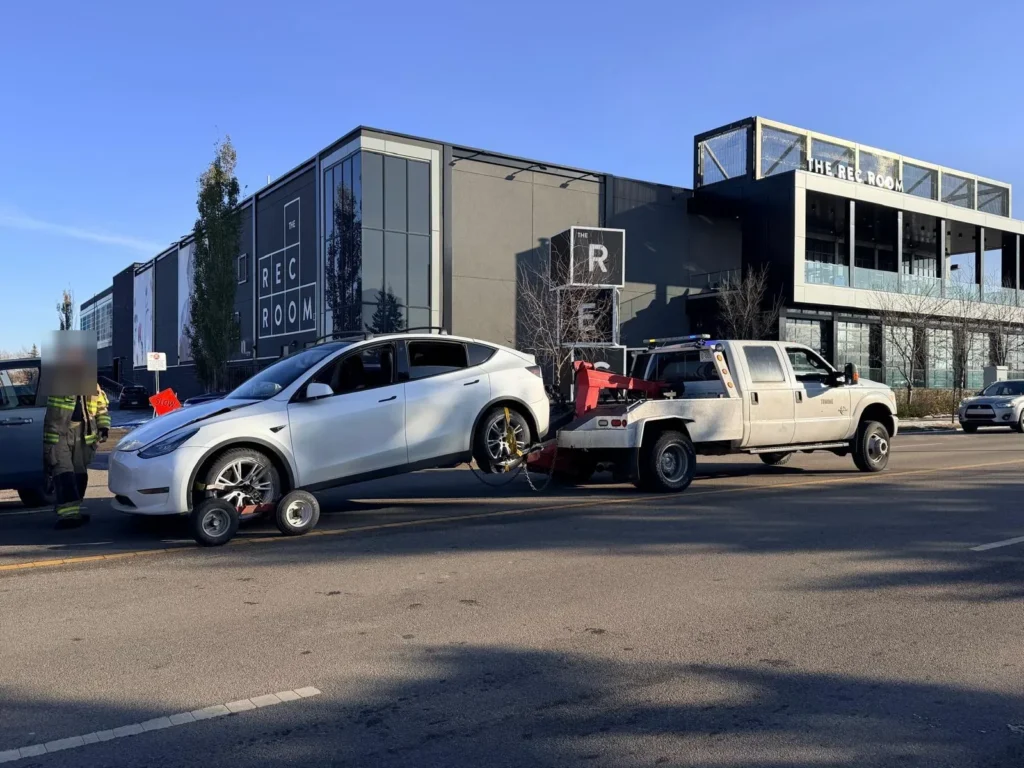
- Electric vehicles. The motors are connected directly to the wheels. Turning the drive wheels on the road can damage them, and EV makers say not to tow with the drive wheels down. We keep all four wheels off the road.
- Steering locked and the car facing the wrong way. Sometimes the only way to lift the end we can reach is to put the other end on dollies.
How to tell what your vehicle is
You do not need to know before you call. We will ask for the year, make and model and work it out with you. If you want to check yourself, here is where to look:
| Where to look | What it tells you |
|---|---|
| Badges on the back: AWD, 4MATIC, xDrive, quattro, 4Motion, SH-AWD, Symmetrical AWD | All-wheel drive. Plan on dollies. |
| Badges reading 4×4 or 4WD | Four-wheel drive. Depends on the system and the manual. |
| A 2H / 4H / 4L knob or lever | Part-time 4WD with a transfer case. Neutral may be possible, but check the manual. |
| Owner’s manual, “Towing” or “Emergency towing” section | The maker’s own answer. This one wins every argument. |
| No badge, front-drive sedan or hatchback | Usually fine on the wheel lift alone, unless something is damaged or locked. |
Some of the most common vehicles in Edmonton are AWD in most of their trims, even when the badge is small or missing. That includes many Subarus, Audis, crossovers sold as AWD by default, and most luxury SUVs. If you are not sure, say so on the phone. That is a perfectly good answer.
Why we do not just use a flatbed
We are upfront about our equipment: we run a wheel-lift truck with dollies, not a flatbed. For cars, SUVs, minivans and light trucks, wheel lift plus dollies gets all four wheels off the road, the same end result a flatbed gives you. It also gets into tight spots a flatbed cannot: underground parkades, narrow back lanes, a car nose-in against a fence.
Where a vehicle is too low, too heavy or too damaged to lift safely this way, we will tell you on the phone and point you to the right truck. We will not try anyway.
What it means for your estimate
Dollies are a separate line on your written estimate. If your vehicle needs them, you will hear that on the phone and see it in writing before we hook up. Alberta’s towing regulation requires a written estimate and your consent before the vehicle is secured. You can read more about that in your rights when your vehicle is towed.
Current rates, including the snow and extreme cold rates, are on our pricing page. We do not quote numbers in blog posts because prices change and old posts stay online for years.
One thing that will not happen: we will not skip the dollies to make a quote look cheaper. A lower number that ends with a damaged transfer case is not a saving.
What to tell us when you call
- Year, make and model, and whether it says AWD, 4WD or 4×4 anywhere on the back
- Whether it will go into neutral, and whether you have the key
- Any damage near the wheels: anything bent, flat, rubbing or leaking
- Where it is parked: street, driveway, parkade (with the clearance height if you know it), or off the road
That is enough for us to tell you whether dollies are needed and give you a full price before we leave. More on the service itself is on our AWD and 4WD towing page. You can also see real jobs, dollies included, in our photo gallery.
Frequently asked questions
Can an AWD car be towed with two wheels on the ground?
Most vehicle makers say no. With two wheels rolling and two lifted, the centre differential or coupling is forced to slip the whole trip with the engine off. We put every AWD vehicle on dollies so all four wheels are off the road.
Is a wheel lift with dollies as safe as a flatbed for an AWD vehicle?
For cars, SUVs and light trucks, yes. The goal is the same with both: no wheel turns on the road. Wheel lift plus dollies achieves that. It also reaches parkades and tight driveways a flatbed cannot.
My 4×4 truck has a neutral setting on the transfer case. Do I still need dollies?
Maybe not. If your owner’s manual allows towing with the transfer case in neutral and it actually shifts into neutral, two wheels down can be fine. If we cannot confirm both, we use dollies.
Do electric vehicles need dollies?
The driven wheels must stay off the road, because the motors are connected to them. On an all-wheel-drive EV that means all four wheels are off the road.
Why would a front-wheel-drive car need dollies?
When the rear wheels cannot roll safely. Common causes are collision damage, a frozen or locked parking brake, or a car stuck in Park with no key.
Will I know about dollies before you arrive?
Yes. If your vehicle needs dollies, we say so on the phone. The charge is also on your written estimate, which you accept before we hook up. Rates are on our pricing page.